

03 Mar Black-headed Trogon (Trogon melanocephalus)
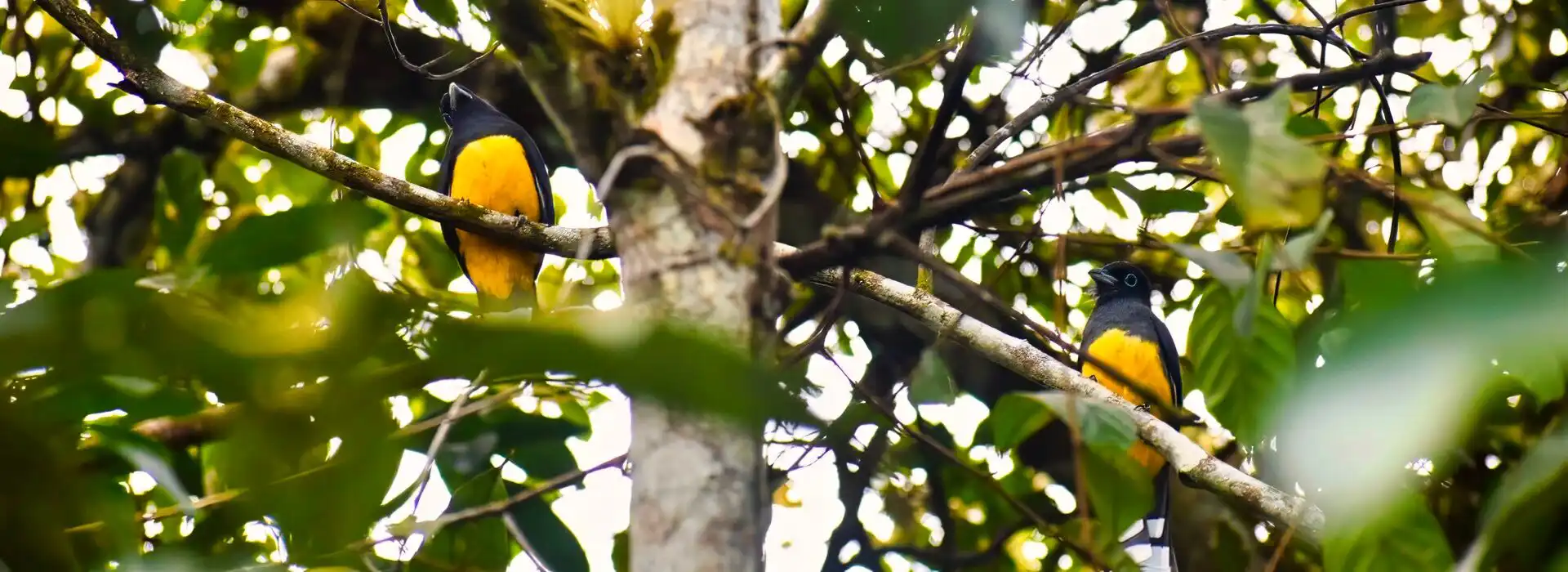
Black-headed Trogon (Trogon melanocephalus)
The Black-headed Trogon (Trogon melanocephalus) is one of the most visually striking tropical birds found from southern Mexico through Central America. With its bold black head, bright yellow belly, and electric turquoise eye ring, this species stands out even in dense forest environments. Birdwatchers and wildlife photographers consistently rank it among their most memorable sightings in tropical dry forests.
In Costa Rica, the Black-headed Trogon thrives in seasonal forests, woodland edges, and river corridors. Although not as famous as some rainforest species, it is often easier to observe due to its calm behavior and preference for semi-open habitats.


Male Characteristics:
– Jet-black head and upper breast
– Bright turquoise-blue eye ring
– Vivid yellow belly
– Distinct white chest band separating dark chest from yellow underparts
Female Characteristics:
– Grayish head instead of black
– Softer yellow belly
– Overall less contrast but same elegant structure
Size: 23–25 cm (9–10 inches) in length.
Structure: Short, broad bill and long squared tail typical of trogons.
Habitat & Distribution
The Black-headed Trogon prefers tropical dry forests, forest edges, open woodland, and secondary growth areas. Unlike rainforest-dependent trogons, this species adapts well to seasonal environments where trees may lose leaves during the dry season.
Its range extends from southern Mexico through Guatemala, Honduras, Nicaragua, Costa Rica, and into northwestern Colombia.
Fun Facts About the Black-headed Trogon
- Masters of Stillness:
Black-headed Trogons often perch motionless for extended periods. They conserve energy and wait patiently before darting out to capture prey.
- Unique Toe Structure:
Like all trogons, they have a heterodactyl toe arrangement—two toes forward and two backward, but arranged differently than parrots or woodpeckers.
- Mixed Diet Strategy:
They feed on both insects and fruits, making them adaptable to seasonal changes in food availability.
- Soft, Repetitive Call:
Their mellow whistling call is often the first indication of their presence. Learning their vocalization dramatically increases sighting success.
Breeding & Nesting Behavior
Breeding season typically aligns with the early rainy season. One of the most fascinating aspects of the Black-headed Trogon is its nesting strategy.
Nesting Habits:
– Nests are excavated in arboreal termite mounds or soft rotting wood.
– Both male and female participate in excavation.
– The cavity provides insulation and protection from predators.
Eggs & Chicks:
– Clutch size: Usually 2–3 white eggs.
– Both parents share incubation duties.
– Chicks remain in the cavity until fully feathered.
Observation & Birdwatching Tips
- Look mid-canopy (3–10 meters above ground).
- Listen carefully for their repetitive whistle.
- Scan dead trees and visible termite mounds.
- Visit early morning for peak activity.
- Move slowly and allow your eyes to adjust to contrast.
Wildlife Photography Tips
– Use a 300–600mm telephoto lens.
– Slightly underexpose to preserve yellow tones.
– Focus sharply on the eye ring.
– Take advantage of their calm perching behavior.
Conservation Status
The Black-headed Trogon is currently listed as Least Concern by the IUCN. However, habitat loss and fragmentation of tropical dry forests remain threats. Protecting seasonal forests ensures stable populations of this species and many others.
The Black-headed Trogon (Trogon melanocephalus) represents the vibrant biodiversity of Central America’s seasonal forests. Its striking colors, calm personality, and fascinating nesting behavior make it a favorite among birders and photographers.
Whether you are an experienced ornithologist or a first-time visitor exploring Costa Rica’s forests, spotting this species is always a rewarding experience.
Sorry, the comment form is closed at this time.