

14 Jul Howler Monkeys in Costa Rica: Habits, Family Life, and Forest Role
Powerful Voices, Strong Social Bonds, and an Essential Role in the Forest
Before sunrise, while the wetlands and forests of Caño Negro are still covered in soft morning light, a deep roar may begin to travel through the trees. It can sound surprisingly powerful—almost like a strong wind, a distant engine, or a much larger animal hidden in the canopy.
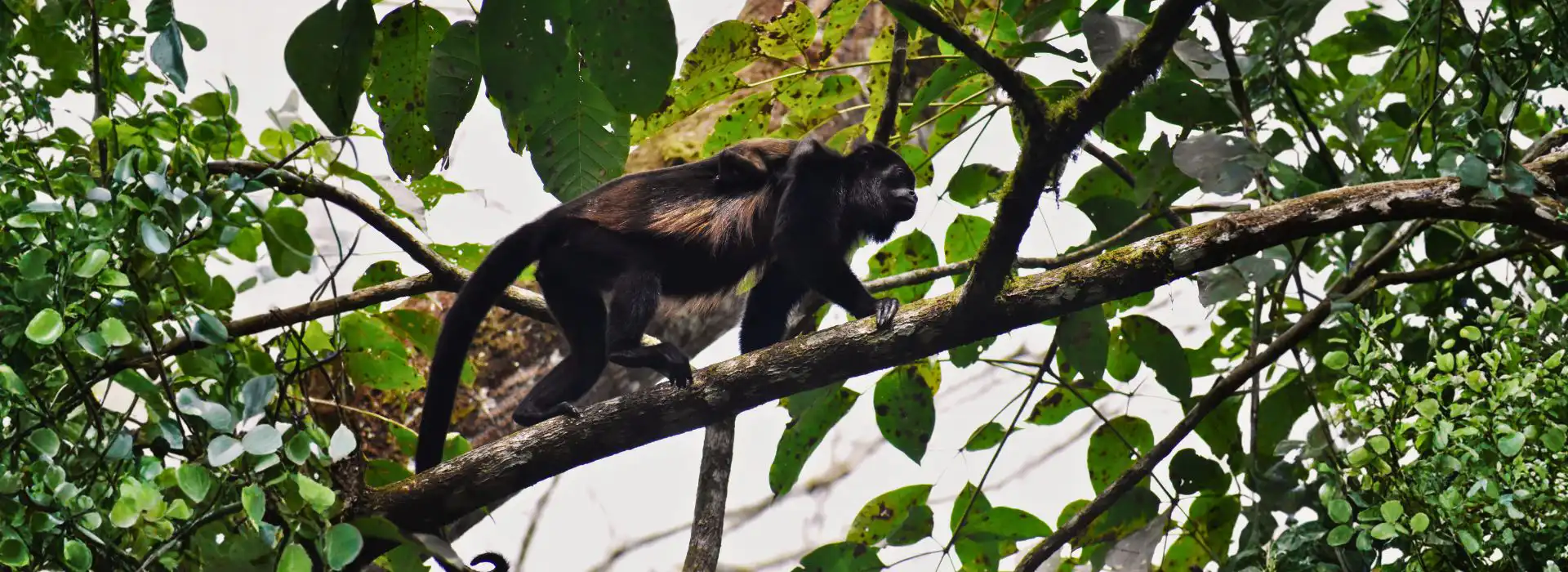
This unforgettable sound belongs to the mantled howler monkey (Alouatta palliata), known in Costa Rica as the mono congo. It is one of the country’s most recognizable mammals and an important inhabitant of tropical forests, river corridors, regenerating woodland, and forest edges.
Howler monkeys are famous for their voices, but their importance goes far beyond their calls. They have organized social lives, close mother-infant relationships, strong communication skills, and an essential ecological role in maintaining healthy tropical forests.


The Voice of the Forest
The characteristic call of a howler monkey is produced with the help of an enlarged hyoid bone in the throat. This specialized structure works like a resonating chamber, allowing the animal to create a remarkably deep and far-reaching sound without needing the body size of a much larger mammal.
In dense forest, the call can travel for a considerable distance. It is often heard around dawn, at dusk, after rain, or when one troop responds to another group in the surrounding forest.
The howling is not random noise. It is a sophisticated form of long-distance communication. A troop can use its calls to announce its location, communicate with neighboring groups, maintain spacing between troops, and reduce the need for direct physical confrontation.
In a habitat where leaves, branches, and distance limit visibility, sound is an efficient tool. The roar allows monkeys to communicate across the canopy while conserving the energy they would otherwise spend traveling or fighting.
A Life in the Canopy
Mantled howler monkeys spend most of their lives in trees. Their long, prehensile tails function almost like an additional limb, helping them maintain balance and securely hold branches while feeding, resting, and traveling.
Their diet consists primarily of leaves, fruit, flowers, and tender shoots. They often select young leaves because they are generally easier to digest and may provide more nutrients than older, tougher foliage. Seasonal changes influence what they eat, especially when fruit or flowers become abundant.
Leaves are plentiful, but they do not provide quick energy. Digesting a leaf-heavy diet takes time, so howler monkeys follow an energy-conscious lifestyle. Visitors may see them resting quietly for long periods, sitting near one another, or stretched across sturdy branches.
This behavior should not be mistaken for laziness. Resting is a highly effective survival strategy. By conserving energy, the monkeys can live successfully on food that is widely available but relatively difficult to digest.
When they move, they usually travel carefully through the canopy. They walk along branches, climb between levels, and stretch across small gaps. Their strong limbs and gripping tails make them remarkably well adapted to life above the forest floor.
More Than a Group: The Social Life of Howler Monkeys
Howler monkeys live in organized troops that may include adult males, adult females, juveniles, and infants. The exact size and composition of a troop can vary depending on habitat, food availability, and the relationships between individuals.
Their society includes social ranks and individual relationships that influence access to food, resting places, and reproductive opportunities. However, troop life is not based only on dominance. It also requires communication, tolerance, recognition, and the ability to live peacefully near other members.
Howler monkeys may use proximity, gentle contact, vocal signals, facial expressions, and body posture to maintain social relationships. They do not need to be constantly active to be socially connected. Simply resting close to familiar individuals can reinforce the stability of the troop.
Young monkeys are especially playful. Juveniles chase one another, climb, wrestle, and explore their surroundings. These activities help them develop balance, strength, coordination, and the social awareness needed to interact with other troop members.
A troop is not always a permanent family in the human sense. As they mature, some males and females may leave the group in which they were born and attempt to join another troop. This movement helps maintain genetic diversity and creates new social relationships between groups.
Mothers, Infants, and Early Learning
The relationship between a mother and her infant is one of the strongest bonds within a howler monkey troop.
During the first weeks and months of life, an infant clings closely to its mother, depending on her for milk, warmth, protection, and transportation. The baby may first cling to the mother’s underside and later ride on her back as it becomes larger and more confident.
As the infant grows, it begins to explore nearby branches, taste leaves, and spend brief periods moving independently. The mother remains close during this vulnerable stage, providing security while allowing the young monkey to practice the skills it will need in the canopy.
By staying near its mother and observing the troop, the infant gradually learns where to rest, how to move safely, which foods to investigate, how to respond to calls, and how to behave around other group members.
Other monkeys may also show interest in infants through gentle touching, close observation, or limited caretaking behavior. These interactions give young monkeys additional opportunities for social development. Through observation, play, and contact, they begin learning the unwritten rules of troop life.
Communication and Cooperation
The famous roar is only one part of howler monkey communication. Within the troop, individuals use softer vocalizations, facial expressions, posture, touch, and movement to share information.
A change in posture may signal discomfort. A short vocal sound may keep an infant close. A dominant individual may communicate confidence without needing to fight. These signals help prevent unnecessary conflict and allow many individuals to share the same trees and feeding areas.
Cooperation in howler monkeys is often subtle. Troop members do not hunt together or build shelters, but their daily survival depends on social awareness. They must coordinate movement, respond to potential threats, recognize established relationships, and maintain enough tolerance to rest and feed near one another.
Their social intelligence is especially visible in the way young monkeys learn from adults. Instead of receiving formal instruction, they watch, imitate, experiment, and gradually develop the skills needed to function independently.
How Howler Monkeys Help the Forest
Howler monkeys do not merely live in the forest. They actively participate in its renewal.
When they eat fruit, they often swallow seeds. These seeds pass through their digestive systems and are deposited elsewhere in the forest. This process helps plants spread beyond the area directly beneath the parent tree, where seedlings would otherwise face intense competition for light, water, and nutrients.
Seed dispersal is one of the most important services that fruit-eating animals provide. By carrying seeds through the canopy and depositing them in new locations, howler monkeys help create the next generation of trees and shrubs.
Their ecological contribution can continue after the seeds reach the ground. Dung beetles and other decomposers are attracted to the organic material in monkey droppings. As they move or bury this material, they may also move seeds, protect some of them from predators, and place them in soil where germination is more likely.
This creates a remarkable chain of ecological relationships: the monkey eats the fruit and transports the seed; insects process the organic material; the seed may germinate; and the resulting plant may later provide food, shelter, or nesting space for many other species.
Howler monkeys also contribute to nutrient cycling. The organic material they deposit returns nutrients to the forest floor, supporting insects, fungi, microorganisms, and soil processes that keep the ecosystem productive.
Why Forest Connectivity Matters
Howler monkeys can survive in several types of forest, including mature rainforest, regenerating woodland, and riverbank habitat. However, because they spend most of their lives above the ground, they depend heavily on connected trees.
When forests are divided by roads, farms, cleared land, or development, monkeys may be forced to descend to the ground or attempt dangerous crossings. Fragmented habitat can also reduce access to feeding trees and make it more difficult for young monkeys to move between social groups.
Protecting riverside vegetation, preserving mature trees, and restoring natural forest corridors can give howler monkeys safer routes through the landscape. These same corridors benefit birds, sloths, reptiles, insects, and many other animals that depend on connected habitat.
Conserving howler monkeys therefore requires more than protecting individual animals. It requires protecting the living connections between trees, rivers, wetlands, and forest patches.
Encountering Howler Monkeys in Caño Negro
In Caño Negro, howler monkeys form part of an extraordinary natural landscape where wetlands, waterways, forest islands, and riverside vegetation meet.
Their presence may first be revealed by sound. A troop can remain almost completely hidden among the leaves while its calls travel across the forest. Spotting them requires patience, quiet observation, and attention to movement high in the canopy.
Wildlife sightings can never be guaranteed, but listening for howler monkeys is part of experiencing the natural rhythm of Caño Negro. Their voices remind us that the forest is active even when many of its inhabitants remain unseen.
Responsible observation means maintaining a respectful distance, avoiding loud noises, never attempting to feed them, and allowing the troop to continue its natural behavior without interruption.
When the Forest Roars, Listen
The call of a howler monkey is one of Costa Rica’s most recognizable natural sounds. Yet behind that impressive voice is a highly adapted primate with an energy-efficient lifestyle, a structured social community, and an essential relationship with the forest.
Howler monkeys raise and protect their young, communicate across great distances, disperse seeds, return nutrients to the soil, and help support the ecological cycles that allow tropical forests to regenerate.
When their voices travel through the trees of Caño Negro, they are doing more than announcing their presence. They are reminding us that a healthy forest is a community—and every species has a role within it.
Sorry, the comment form is closed at this time.