

26 Jun Iguanas in Caño Negro, Costa Rica | Natural Lodge Caño Negro
Iguanas in Caño Negro: Ancient Reptiles of the Tropical Wetland
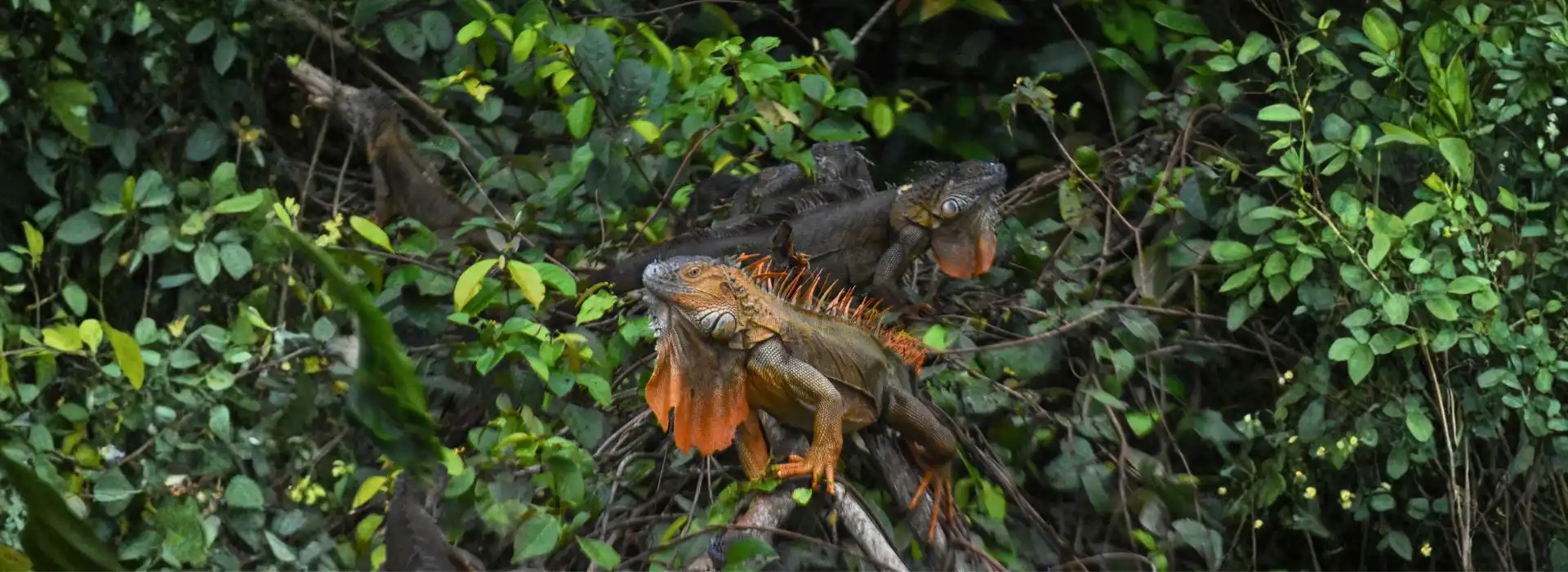
At first glance, an iguana may seem perfectly still, almost like part of the branch where it rests. But look closer, and you begin to notice the details: the alert eye, the powerful legs, the long tail, the textured scales, and the impressive spines running along its back. In Caño Negro, iguanas are one of those animals that remind us that the wetland is not only a paradise for birds, but also a living home for reptiles, mammals, amphibians, insects, and countless forms of tropical life.
The iguana is one of the most recognizable reptiles in Costa Rica. Around rivers, gardens, forest edges, and sunny branches, these animals move between water, trees, and vegetation with surprising ease. Their prehistoric appearance often captures the attention of visitors, especially when a large adult male appears with bright orange tones, a strong dewlap, and a confident posture among the leaves.
In Caño Negro, seeing an iguana is more than just a wildlife moment. It is a small window into the balance of the tropical ecosystem.


A Reptile Built for the Tropics
The most commonly recognized iguana in Costa Rica is the Green Iguana (Iguana iguana), although adult males are not always green. Depending on age, season, mood, and breeding condition, they may show gray, brown, olive, or even intense orange coloration. This is one reason many visitors are surprised when they see a large orange iguana and learn that it may still be a Green Iguana.
Their bodies are perfectly adapted to warm, tropical environments. Iguanas are ectothermic, meaning they depend on external heat sources to regulate their body temperature. This is why they are often seen basking in the sun during the morning, absorbing heat before becoming more active.
Their long claws help them climb trees, their strong tails assist with balance and defense, and their excellent swimming ability allows them to escape danger by dropping into the water. In wetland habitats like Caño Negro, this connection between trees and water is especially important.
Why Iguanas Love Wetland Habitats
Caño Negro offers many of the conditions iguanas need to survive: vegetation, sunlight, trees, water, and quiet areas where they can rest or hide. Iguanas are often associated with rivers, canals, lagoons, and forested edges because these places provide both food and protection.
The trees and shrubs near the water serve as natural lookout points. From there, an iguana can warm itself, feed on leaves, flowers, or fruits, and quickly escape if it senses a threat. When disturbed, an iguana may remain completely still, run along a branch, or leap into the water with surprising speed.
For nature photographers, this behavior creates excellent opportunities. Iguanas can be photographed as part of the landscape, blending into the vegetation, or as close portraits that reveal the incredible texture of their scales and the intensity of their eyes.
What Do Iguanas Eat?
Iguanas are mostly herbivorous, especially as adults. Their diet includes leaves, flowers, fruits, and tender plant shoots. In this way, they play an important role in the ecosystem. By feeding on vegetation and sometimes moving seeds through the landscape, they contribute to the natural cycle of plant life.
Young iguanas may occasionally consume small insects or other animal matter, but as they mature, plant material becomes the main part of their diet.
This plant-based diet is one of the reasons iguanas are often found in gardens, forest edges, and areas with abundant vegetation. At Natural Lodge Caño Negro, the surrounding greenery creates a natural environment where reptiles, birds, and other wildlife can move through the property and nearby habitats.
The Meaning of the Dewlap and Spines
One of the most striking features of an iguana is the large flap of skin hanging under its throat, known as the dewlap. This structure is not just decorative. Iguanas use it for communication, display, and thermoregulation.
A male iguana may extend its dewlap to appear larger, signal dominance, attract a mate, or warn another iguana to keep its distance. Combined with head-bobbing movements and body posture, the dewlap becomes part of a visual language that is easy to miss unless you take time to observe.
The row of spines along the back also gives iguanas their iconic appearance. These spines are more pronounced in males and help make them look larger and more impressive. For photographers and wildlife watchers, these details are part of what makes iguanas such fascinating subjects.
A Calm Animal, But Always Alert
Iguanas may appear relaxed, but they are constantly aware of their surroundings. Their eyes scan for movement, their bodies respond to changes in temperature, and their position often gives them an escape route.
This is one of the best lessons iguanas offer to visitors: wildlife observation requires patience. The more time you spend watching quietly, the more behavior you begin to notice. A motionless reptile suddenly becomes an animal with personality, strategy, and purpose.
You may see an iguana lifting its head, adjusting its body to catch the sun, slowly chewing leaves, or moving carefully through branches. These simple moments reveal the rhythm of life in the wetland.
Iguanas and the Caño Negro Experience
Many people visit Caño Negro for birds, especially waterbirds, raptors, kingfishers, herons, and migratory species. But one of the great surprises of this destination is how much life appears between bird sightings.
An iguana resting beside the water, a basilisk running near the edge of a trail, a caiman floating silently, a frog calling after rain, or monkeys moving through the canopy all form part of the same story. Caño Negro is not only a birding destination. It is a complete tropical ecosystem.
For guests at Natural Lodge Caño Negro, the experience often begins right outside the room, in the gardens, along the trails, near the water, or during a quiet moment after breakfast. Nature here is not something that only appears during a tour. It is present throughout the day.
Photography Tips for Iguanas
Iguanas are excellent subjects for nature photography because they combine texture, color, behavior, and habitat. To photograph them well, patience is key.
Early morning is often a good time because iguanas may be basking and less active while warming up. Soft light also helps bring out the details in their scales without creating harsh shadows.
For a strong image, focus on the eye. A sharp eye gives life to the photograph and creates a stronger connection with the viewer. Including some surrounding vegetation can also help tell the story of the habitat, especially in a place like Caño Negro where the environment is part of the experience.
When photographing iguanas, always keep a respectful distance. Avoid chasing, touching, feeding, or forcing the animal to move. The best wildlife images come from natural behavior.
Why Iguanas Matter
Iguanas are more than beautiful reptiles. They are part of the ecological network of the wetland. They interact with plants, serve as prey for larger animals when young, and help maintain the natural balance of their environment.
Their presence is also a reminder of the importance of protecting tropical habitats. Wetlands like Caño Negro support an extraordinary variety of life, from tiny insects to large birds, from amphibians to reptiles, and from aquatic species to mammals in the forest.
When we protect these places, we protect the relationships between species. We protect the branches where iguanas rest, the trees that feed them, the water where they escape, and the quiet spaces where wildlife continues its daily rhythm.
A Prehistoric Face in a Living Wetland
Watching an iguana in Caño Negro feels like observing a creature from another time. Its rough scales, strong body, and calm presence give it a prehistoric elegance. But this animal is not a relic of the past. It is an active, living part of the tropical wetland.
The next time you walk through the lodge gardens, explore the river, or pause near the vegetation, take a moment to look carefully. An iguana may be watching from a branch, perfectly still, blending into the green world around it.
In Caño Negro, every detail matters. Even a quiet reptile resting in the shade can tell a story about adaptation, survival, and the richness of nature.
Sorry, the comment form is closed at this time.