

04 May Rufous-tailed Jacamar in Caño Negro: Where to See This Stunning Bird
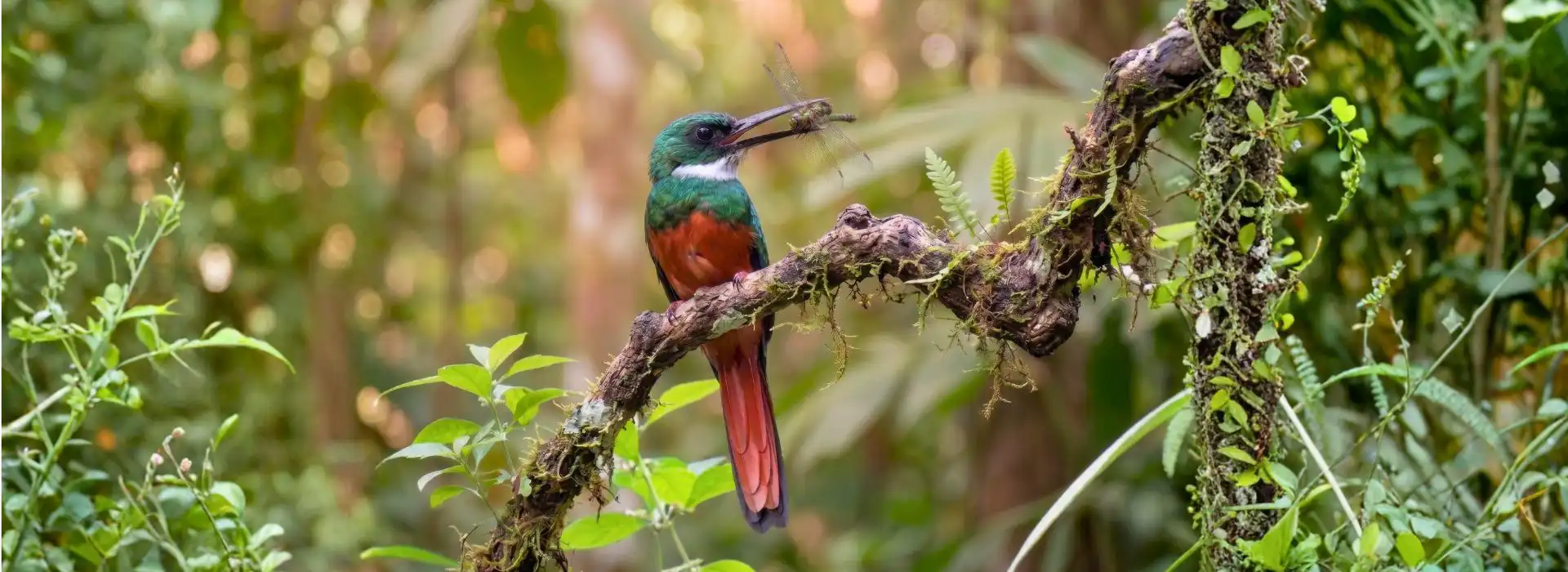
Rufous-tailed Jacamar: A Flash of Color in the Living Wetland
In a place like the Refugio Nacional de Vida Silvestre Caño Negro, where nature never stops moving, some moments feel almost unreal. One of those is spotting the Rufous-tailed Jacamar (Galbula ruficauda), a bird that looks like it belongs more in a painting than in the wild.
With its metallic green body, warm rufous tail, and long needle-like bill, this species is one of the most visually striking birds you can encounter around Natural Lodge Caño Negro. But beyond its beauty, the jacamar is also a fascinating predator and a rewarding subject for birdwatchers and photographers alike.
A Jewel Hidden in Plain Sight
At first glance, the Rufous-tailed Jacamar can be easy to miss. It tends to perch quietly on exposed branches, often at eye level, scanning the air with remarkable patience.
What gives it away is the iridescent green plumage, which glows intensely when light hits it at the right angle. Its rufous-colored tail contrasts perfectly, creating a color combination that feels almost designed.
Unlike many tropical birds that move constantly, the jacamar prefers stillness—making it a perfect subject for photography once you spot it.


A Master of Precision Hunting
The Rufous-tailed Jacamar feeds primarily on flying insects—dragonflies, butterflies, and large beetles.
Its hunting technique is simple but incredibly effective:
- It perches silently on a branch
- Watches the air for movement
- Launches in a quick, direct flight
- Snatches the insect mid-air
- Returns to the exact same perch
This behavior, known as ‘hawking,’ is repeated over and over, often from the same branch.
Where to Find It in Caño Negro
The Rufous-tailed Jacamar thrives in open woodland, forest edges, and near water, making Caño Negro an ideal habitat.
Around Natural Lodge Caño Negro, they are often seen:
- Along sunny trails and forest edges
- Near clearings where insects are abundant
- Perched on thin, exposed branches
- Close to water channels and lagoons
They are not rare—but they are selective. The key is light and patience.
Best Tips for Birdwatchers & Photographers
- Look for the perch, not the bird
- Use the light (early morning or late afternoon)
- Stay still
- Watch the airspace
A Bird That Defines the Experience
In a destination known for abundance, the Rufous-tailed Jacamar represents precision, elegance, and timing.
It’s not the loudest bird, nor the biggest—but it’s often one of the most memorable.
At Caño Negro, where every branch can hold a surprise, the jacamar reminds us that sometimes the most extraordinary encounters happen when you simply stop and watch.
Sorry, the comment form is closed at this time.